
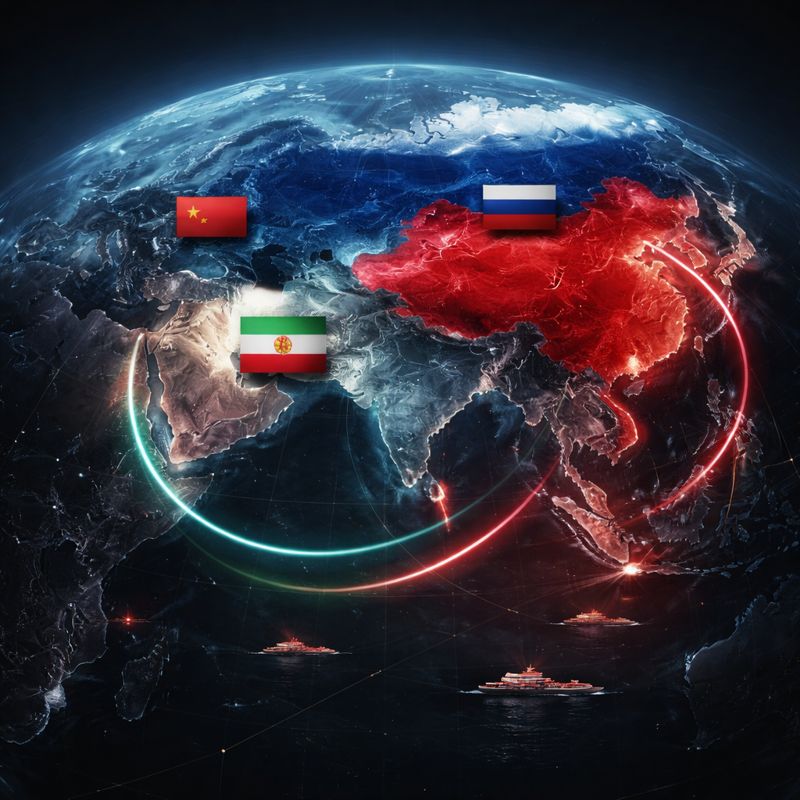
The New Map of Geopolitical Risk: How the China-Russia-Iran Axis is Reshaping the Global Operating Environment
Executive Summary: A Fundamental Shift in the Global Order
For decades, corporate and government risk models have been built on a foundational assumption: a global operating environment largely stabilized by a US-led, rules-based order. That assumption is now obsolete. The steady withdrawal of US influence from key regions, combined with the rise of a cohesive China-Russia-Iran axis, has created a new geopolitical reality. This is not a threat management issue; it is a fundamental restructuring of the global ecosystem for market entry and sustained operations.
This report analyzes the evolution of the China-Russia-Iran partnership, culminating in the January 2026 BRICS naval exercises off South Africa, and explains why this signals a new era of geopolitical risk. Where this new bloc becomes the dominant influencer, the rules of the game will change—from contract enforcement to infrastructure standards. Understanding where this influence will emerge, and what it will look like, is now the central challenge for global risk management.
- The End of the Unipolar Moment: The US withdrawal from Africa, Latin America, and global institutions has created an influence vacuum that is being actively filled by China, Russia, and Iran.
- From Transactional to Strategic: The China-Russia-Iran relationship has evolved from a loose, transactional alignment to a cohesive strategic project with deep military and economic cooperation.
- The Exercises as a Leading Indicator: The evolution of their joint naval exercises from regional defense to global power projection is a clear signal of their ambition and capability.
- The New Risk Calculus: The emergence of this bloc requires a fundamental reassessment of supply chain security, partner-nation reliability, and the efficacy of Western sanctions.
- The Dominant Influencer Framework: The key question for risk managers is no longer just “is this country stable?” but “who is the dominant influencer here, and what are their rules?”
Part 1: The Erosion of the Old Order – A Timeline of Transition
The current geopolitical landscape did not emerge overnight. It is the result of two parallel trends over the past decade: the strategic convergence of China, Russia, and Iran, and the simultaneous retrenchment of US influence.
The Convergence of the Revisionists: A Partnership Forged in Opposition
The strategic partnership between China, Russia, and Iran is not a formal alliance, but a deeply pragmatic and increasingly cohesive bloc forged by a shared opposition to the US-led global order. All three nations have faced Western sanctions and exclusion from key global institutions, creating a powerful incentive to build an alternative system.
- China-Russia: From a “strategic partnership” in 1996 to a “no limits” partnership in 2022, this relationship has become the anchor of the new bloc. Russia’s post-2014 turn to the East after the annexation of Crimea, and its further isolation after the 2022 Ukraine invasion, made China an indispensable partner.
- China-Iran: China has been a key partner for Iran since the 1979 Islamic Revolution. This relationship was formalized with a Comprehensive Strategic Partnership in 2016 and a 25-year, $400 billion cooperation program in 2021, providing a critical economic lifeline for Tehran.
- Russia-Iran: Deepened by their joint intervention in Syria in 2015, the Russia-Iran military relationship has accelerated dramatically since 2022, with Iran supplying Russia with critical military hardware for its war in Ukraine.
The American Retrenchment: A Vacuum of Influence
Simultaneously, the United States has been strategically retrenching from key regions, creating an influence vacuum that this new axis has been eager to fill.
- Africa: The 2024 withdrawal of US forces from Niger, a key counter-terrorism hub, was the culmination of a multi-year reduction in US military presence across the Sahel. This has been met with a rapid expansion of Russian (via Wagner/Africa Corps) and Chinese influence in the region.
- Latin America: A decades-long focus on the Middle East, followed by a strategic “pivot to Asia,” has left a power vacuum in America’s own hemisphere. The January 2026 US intervention in Venezuela, while a tactical success, has created a significant diplomatic backlash, further eroding US influence.
- Global Institutions: The January 2026 announcement of the US withdrawal from 66 international organizations, including 31 UN bodies, signals a broader retreat from the very global governance structures the US helped create. This cedes the field to China and its allies to reshape these institutions from within.
This confluence of convergence and retrenchment set the stage for the China-Russia-Iran axis to move from a defensive posture to an assertive, global one.
Part 2: From the Gulf of Oman to the Cape of Good Hope – The Exercises as a Strategic Signal
A historical analysis of the joint naval exercises from 2019 to 2026 reveals a clear and deliberate pattern of evolution across five key dimensions. This is not a series of disconnected events, but a methodical, phased strategic project.
1. Geographic Evolution: From Regional Consolidation to Global Projection
The most significant change has been the geographic scope. From 2019 to 2025, the exercises were consistently held in the Northern Indian Ocean and Gulf of Oman, a defensive posture focused on protecting China’s energy lifelines through the Strait of Hormuz. The January 2026 drills off South Africa represent a qualitative leap. This 7,000-mile relocation to the Cape of Good Hope—a critical Western maritime corridor—is a clear demonstration of expeditionary capability and the ambition to operate globally.
2. Institutional Evolution: From Informal Trilateral to Formal Multilateral
The exercises have matured from an informal, ad hoc trilateral arrangement into a formalized multilateral endeavor. Iran’s integration into Shanghai Cooperation Organisation (SCO) military structures in December 2025, followed by the January 2026 exercises under the BRICS framework, provides legitimacy, permanence, and a mechanism for expansion. The inclusion of South Africa as a full participant is the first concrete step in this process, leveraging the 11-member BRICS bloc as a platform to integrate other non-Western nations.
3. Sophistication Evolution: From Basic Drills to Combined-Arms Operations
The operational complexity has steadily increased. The initial 2019 drills focused on basic anti-piracy and maritime security. By 2022, Russia had deployed a cruiser, and by 2025, the exercises included advanced scenarios like night live-fire drills and combined aerial-naval maneuvers. This demonstrates a clear focus on building true interoperability and warfighting capability, moving far beyond simple security patrols.
4. Frequency Evolution: From Ad Hoc to Routinized
After a pause in 2020 due to the COVID-19 pandemic, the exercises became an annual fixture. The year 2025 marked an acceleration, with two major exercises held (the trilateral “Security Belt” in March and the SCO’s “Sahand-2025” in December). This increasing tempo signals a deep strategic commitment and the institutionalization of this security partnership.
5. Strategic Messaging Evolution: From Defensive Justification to Assertive Signaling
The narrative surrounding the drills has shifted from a defensive crouch to a confident assertion. Early messaging focused on anti-piracy and protecting trade. By 2026, the messaging, combined with the provocative location and timing, is a deliberate signal to the West about the existence of a viable, non-Western security architecture.
Part 3: Why This Matters – A New Framework for Geopolitical Risk
For corporate and government entities, the emergence of this new bloc is not a distant military issue; it is a direct challenge to the foundational assumptions of global risk management. The operating environment is no longer defined by a single, US-led set of rules. Instead, we are entering a world of competing influence zones, each with its own norms, standards, and enforcement mechanisms.
The Dominant Influencer Model: Who Sets the Rules?
In any given market, the critical risk question is now: Who is the dominant influencer? Where the China-Russia-Iran axis holds sway, organizations must be prepared for a different operating reality:
- Contract Enforcement: Disputes may be settled not by international arbitration courts, but by local power brokers aligned with Beijing, Moscow, or Tehran.
- Infrastructure and Technology Standards: Markets will increasingly be built on Chinese technology standards (e.g., Huawei, CIPS), creating interoperability and data security challenges for Western firms.
- Regulatory and Compliance Environments: Labor laws, environmental regulations, and anti-corruption standards will reflect the priorities of the dominant influencer, not Western norms.
- Financial Systems: The promotion of alternative payment systems (like China’s CIPS) and discussions around a BRICS currency will create new complexities for financial transactions and capital repatriation.
The New Geopolitical Risk Calculus: Three Core Shifts
- Supply Chain Security is No Longer a Given. The assumption of secure maritime passage through key corridors policed by Western navies is obsolete. The presence of a competing naval bloc in critical chokepoints like the Cape of Good Hope introduces new vulnerabilities that demand urgent diversification and contingency planning.
- Partner-Nation Reliability Must Be Reassessed. South Africa’s full participation in the 2026 drills is a watershed moment. It demonstrates that even historically neutral or Western-leaning nations in the “Global South” are now willing to align with this alternative bloc. The geopolitical alignment of all countries in a company’s supply chain and operational footprint must be re-evaluated.
- Sanctions and Economic Warfare are Becoming More Complex. The BRICS framework provides a potential economic and security cushion for sanctioned nations, making Western sanctions less effective and creating a more challenging compliance landscape for multinational corporations.
Conclusion: Navigating the New Map of Global Risk
The evolution of the China-Russia-Iran joint exercises is more than a military development; it is a leading indicator of the consolidation of a new, powerful, and assertive geopolitical bloc. The era of a single, predictable, US-led global order is over. For organizations to survive and thrive in this new environment, they must discard outdated risk models and adopt a new framework centered on identifying the dominant influencer in each market and understanding the new rules of the game they bring. The map of global risk has been redrawn; it is time to learn how to navigate it.